Mastek Intelligent Packing Machinery (Suzhou) Co., Ltd
- +86 512 8781 7868
- export@mastekpack.com



Mastek Intelligent Packing Machinery (Suzhou) Co., Ltd
A Strapping Machine feeds strap around a carton, bundle, or pallet load, tensions it, seals the overlap, cuts the excess, and repeats the cycle. Manual, semi-automatic, and fully automatic models mainly differ in operator involvement, throughput, and integration with conveyors or packaging lines. I use this guide to explain the machine’s components, operating sequence, applications, safety requirements, troubleshooting methods, and buying criteria.
A strapping machine secures cartons, bundles, and pallets by applying measurable tension and a sealed strap joint.
The operating cycle includes strap feeding, load positioning, tensioning, sealing, cutting, and machine reset.
Manual, semi-automatic, and fully automatic systems suit different volumes, load sizes, labor models, and line layouts.
Strap material, width, thickness, tension, load stability, and access clearance directly affect package security.
Buying decisions should compare daily volume, cycle time, dimensions, service support, safety controls, and total ownership cost.
A strapping machine is packaging equipment that applies plastic or other approved strap around a product or load to hold components together during storage, handling, and transportation. The strap is usually made from polypropylene for lighter cartons or polyester for higher-load applications. Depending on the design, the machine can process individual boxes, bundles, palletized products, or loads moving through an automated conveyor system.
The machine solves several problems associated with hand strapping. It produces more repeatable strap placement, applies controlled tension, reduces repetitive pulling and cutting, and creates a consistent sealed joint. For shipping operations, the result is a load that is less likely to separate, shift, or lose individual cartons during forklift movement and transit.
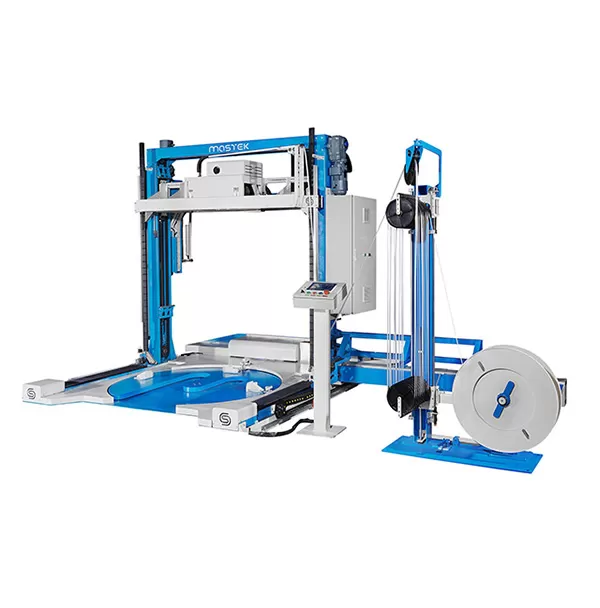
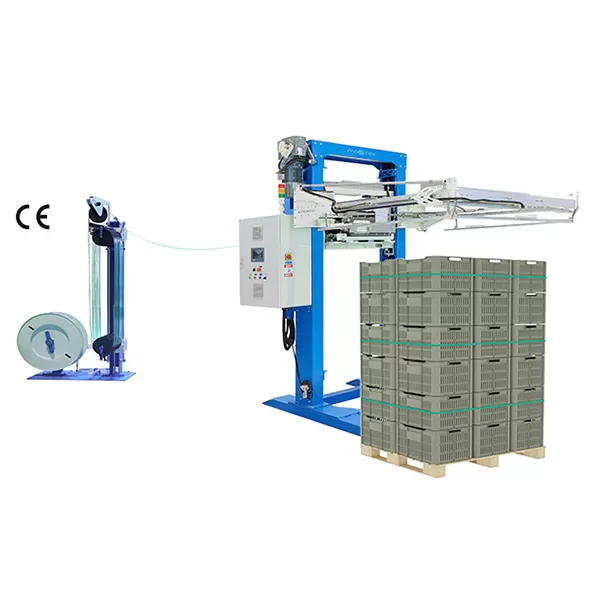
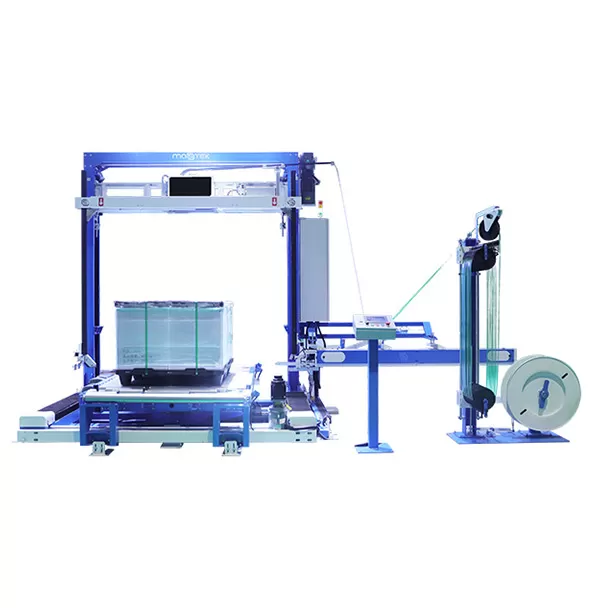
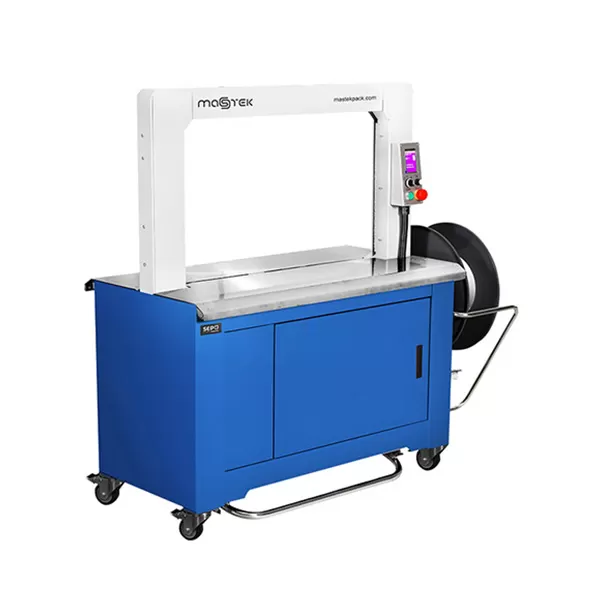
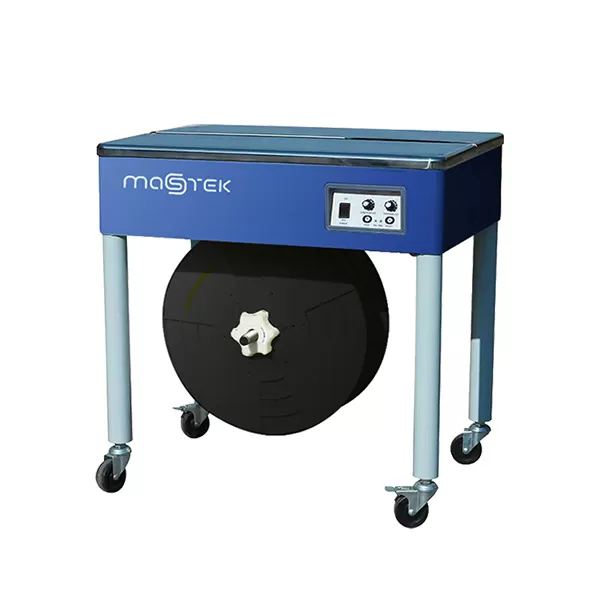
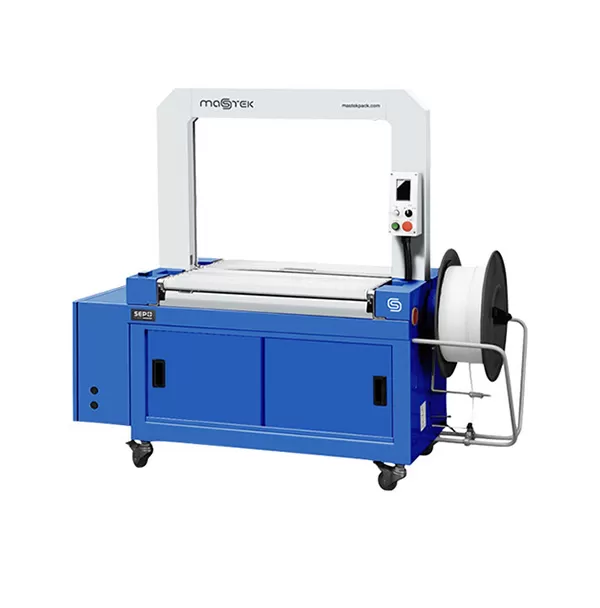
Mastek is one example of a manufacturer offering semi-automatic carton strapping equipment, automatic strapping machines, pallet strapping systems, and combined wrapping-and-strapping equipment. Its product range includes the MK60S semi-automatic machine, MK60 and MK60P automatic carton systems, and MK300, MK600, and MK900 pallet-focused machines.
Before selecting or operating a machine, I recommend recording the load dimensions, daily package count, required strap material, available floor space, electrical supply, and conveyor arrangement. These variables determine whether a low-cost semi-automatic machine is sufficient or whether the operation requires an automatic packaging machinery system. They also affect installation, maintenance access, guarding, and operator movement.
You should also identify the strap specification approved for the product. Record the strap width, thickness, coil dimensions, material type, required tension range, and sealing method. A machine designed for polypropylene strapping may not deliver the same result with polyester strapping unless its guides, heating system, tensioner, and sealing head support that material.
An automatic strapping machine completes the main packaging cycle with limited operator input. The package is placed over or between the machine’s guides, sensors confirm its position, and the machine feeds strap around the load. The strap then returns to the sealing head, where it is tensioned, joined, cut, and prepared for the next cycle.
The strap begins on a coil dispenser and travels through guide rollers, feed wheels, and a strap channel. Feed rollers control the movement and help prevent slack, twisting, or misalignment. Position sensors determine whether the load is correctly placed before the machine starts the tensioning cycle.
For pallet systems, positioning becomes more demanding because the machine must accommodate load width, height, pallet openings, and strap paths. Mastek’s MK600 technical data lists standard load dimensions of 1,200 × 1,200 millimeters, with options extending to 1,400 × 1,400 millimeters and a standard height range reaching 1,500 millimeters.
After the strap surrounds the load, a motorized tensioning system pulls the free end until the programmed value is reached. Tension must be high enough to stabilize the load but low enough to avoid crushing cartons, cutting into product edges, or deforming flexible packaging. The correct setting depends on load compression resistance, strap material, carton strength, and transport conditions.
The MK600 specification provides an adjustable tension range of 500 to 3,000 newtons. This illustrates why tension should be selected from measured packaging trials rather than by using the highest available setting. An unstable pallet may require improved load arrangement or additional straps instead of simply increasing tension.
Once the target tension is reached, the machine seals the overlapping strap ends. Common methods include heat sealing, friction welding, and ultrasonic sealing. Heat sealing requires controlled temperature and contact time, while friction and ultrasonic systems generate a joint through mechanical energy or high-frequency vibration.
The sealing head must match the strap material and thickness. An unsuitable combination can produce a joint that looks closed but separates under load. Operators should inspect the joint for full contact, consistent width, clean edges, and signs of melting, burning, incomplete fusion, or excessive deformation.
After sealing, the cutter removes the remaining strap tail. The machine releases tension, opens or clears the strap path, and resets the head for the next cycle. Sensors then confirm that the strap has returned to its starting position and that the next package can enter safely.
A missed reset can create several symptoms, including strap feeding errors, repeated alarms, incomplete loops, or a machine that stops after one cycle. When diagnosing these problems, I check the cutter, strap channel, return sensor, feed rollers, and control-panel alarm code in that order.
I begin each shift by checking the strap coil, guide path, sealing head, emergency-stop buttons, guards, electrical connections, and floor area around the machine. The operator should confirm that the load is stable and that no hands, tools, or loose materials are inside the strap path. The machine should never be operated with bypassed guards or disabled sensors.
The main hazards are pinch points near the tensioning and sealing head, strap recoil after cutting, hot surfaces on heat-sealing equipment, and unexpected movement during automatic cycling. Operators should keep their hands away from the strap loop, stand outside the recoil path, and wait for the machine to complete its release cycle before removing the package.
Maintenance requires a lockout procedure. I isolate the electrical supply, release stored tension, allow heated parts to cool, secure moving components, and verify zero movement before clearing jams or replacing parts. Emergency stops are intended for abnormal situations, not as a substitute for isolation during routine servicing.
Operator posture also affects safety and productivity. A semi-automatic machine should be positioned so the operator can place cartons without repeated twisting, excessive reaching, or lifting above a comfortable working height. For heavier loads, conveyors, turntables, pallet positioners, or integrated handling equipment can reduce manual movement.
The difference between these machine types is primarily the amount of operator involvement and the level of connection to upstream or downstream equipment.
| Machine type | Operator involvement | Typical application | Main limitation |
|---|---|---|---|
| Manual strapping | Operator positions, tensions, seals, and cuts the strap | Very low-volume cartons or irregular bundles | Variable tension, slower cycles, and greater repetitive effort |
| Semi-automatic | Operator places the package and activates the cycle; machine tensions, seals, and cuts | Small businesses, warehouses, and mixed carton sizes | Packages still require manual positioning |
| Fully automatic | Conveyor or production system presents the load; machine completes the cycle automatically | High-volume packaging lines and standardized cartons | Higher purchase price, installation requirements, and integration work |
For low-volume cartons, manual or semi-automatic equipment may provide the lowest initial cost. For mixed-size packages, a semi-automatic strapping machine gives the operator flexibility to adjust placement without requiring a complete conveyor system. For pallet loads, automatic vertical or horizontal equipment is usually more appropriate because the strap must be positioned around a larger and heavier load.
Fully automatic systems become practical when daily volume is high enough for reduced labor time and consistent cycle performance to offset installation and maintenance costs. Mastek lists the MK600 at approximately 15 to 25 pallets per hour, depending on product height and width. Actual output should still be validated using the customer’s load dimensions, strap count, conveyor speed, and handling sequence.
Polypropylene strapping is commonly used for lighter cartons, printed materials, and general distribution packages. It is relatively flexible and suitable where moderate holding force is sufficient. Polyester strapping is generally selected for heavier loads or applications requiring greater retained tension and resistance to load movement.
The strap width and thickness must match the sealing head, tensioner, guides, and product requirements. For example, the MK600 data identifies PET options including 12-millimeter-wide, 0.8-millimeter-thick strap and 15-millimeter-wide, 0.8-millimeter-thick strap, as well as a 15-millimeter-wide, 1.0-millimeter-thick PP option.
Poor results may come from strap quality rather than machine failure. A strap coil with inconsistent width, surface contamination, excessive brittleness, or poor weld compatibility can cause feed jams, weak seals, uneven tension, and premature breaks. I recommend testing the exact strap batch with representative cartons or pallets before approving a production setting.
Load design is equally important. Unstable cartons, blocked pallet access, uneven top surfaces, and excessive gaps can prevent the strap from sitting in the correct position. In these cases, the machine may complete its cycle correctly while the finished load remains unsafe because the packaging configuration itself is unsuitable.
A useful troubleshooting process connects each failure to the part of the cycle where it occurs. I first identify whether the fault happens during feeding, positioning, tensioning, sealing, cutting, sensor confirmation, or load handling. This approach avoids replacing unrelated parts and helps maintenance staff document repeat failures.
| Symptom | Likely causes | Checks and corrective actions |
|---|---|---|
| Strap does not feed | Empty coil, twisted strap, blocked guide, worn feed wheel | Inspect coil direction, clear the channel, clean rollers, and verify wheel pressure |
| Strap is loose | Incorrect tension setting, slipping roller, unstable load | Test tension, inspect roller grip, improve load arrangement, and confirm strap material |
| Strap breaks | Excessive tension, brittle strap, sharp carton edge, incorrect width | Reduce tension, test a new coil, protect edges, and confirm specifications |
| Seal opens | Wrong temperature, friction setting, ultrasonic setting, or strap type | Match settings to material and inspect the sealing head for wear or contamination |
| Cutter leaves a tail | Dull blade, incorrect alignment, incomplete release | Inspect blade condition, clean the cutter, and verify the release sequence |
| Machine will not cycle | Sensor blocked, guard open, emergency stop active, load misaligned | Check sensors, safety circuits, package position, and alarm messages |
| Pallet strap is misplaced | Incorrect load dimensions, blocked access, poor centering | Measure the load, adjust guides, center the pallet, and remove obstructions |
A maintenance log should record the date, machine cycle count if available, strap material, fault code, load type, corrective action, and whether the problem returned. Repeated failures often reveal a mismatch between machine settings and packaging materials rather than a single defective component.
I use seven measurable criteria when comparing equipment: daily volume, required cycle time, load dimensions, strap width, tension range, automation level, and service availability. Total cost of ownership should include the machine, installation, strap consumption, replacement blades, sealing-head components, electricity, operator time, preventive maintenance, and downtime risk.
| Business requirement | Suitable machine direction | Why |
|---|---|---|
| Fewer than several dozen cartons per day | Manual or semi-automatic | Lower capital cost and flexible package handling |
| Mixed-size cartons in a warehouse | Semi-automatic | Operator can position different boxes quickly |
| Repeated carton sizes and steady volume | Automatic carton strapping | Consistent cycling and easier conveyor integration |
| Palletized loads with vertical access | Automatic vertical pallet strapping | Applies straps around the load from the pallet side or top path |
| Large pallet loads requiring horizontal access | Automatic horizontal pallet strapping | Suits wider load formats and horizontal strap placement |
| High-volume production line | Fully automatic with conveyor | Reduces manual presentation and supports line synchronization |
| Wrapping and strapping in one process | Integrated wrapping-and-strapping system | Combines two end-of-line operations in a single layout |
For a small business, the best strapping machine is not automatically the fastest model. I compare expected daily volume with the machine’s cycle time, available labor, carton variation, floor space, and ability to support future growth. A semi-automatic system may be the right starting point if package sizes change frequently, while a conveyor-connected automatic machine becomes more practical when package flow is stable.
Service availability should be evaluated before purchase. Ask about spare sealing heads, cutters, sensors, feed rollers, electrical components, remote support, installation training, warranty duration, and response time. Mastek product information identifies one-year machine coverage and, for certain pallet models, three-year coverage for the strapping head; those terms should be confirmed for the exact configuration being ordered.
The main reason to use a strapping machine is process consistency. Controlled tension and repeatable sealing can reduce variation between operators, while automated cutting and resetting shorten the number of manual actions per package. The practical benefit depends on volume, labor rates, strap consumption, product damage, and downtime, so I recommend comparing measured before-and-after results rather than relying on general claims.
A machine is particularly useful when cartons must remain grouped through transportation, pallets need additional load stability, or employees perform the same strapping motion throughout a shift. It can also support carton sealing and strapping as part of a wider packaging line. However, equipment should not be used to compensate for poor pallet stacking, weak cartons, incorrect strap selection, or insufficient load containment.
What Is a Strapping Machine and How Does It Work? In practical terms, it is packaging equipment that feeds strap around a load, applies controlled tension, seals the overlap, cuts the excess, and resets for the next cycle. Manual, semi-automatic, and fully automatic machines differ mainly in operator involvement, throughput, load handling, and integration with conveyors or other packaging equipment.
I recommend starting with measured operating data: daily cartons or pallets, target cycle time, load dimensions, strap material, required tension, and available service support. Then compare manual, semi-automatic, and automatic options using total cost of ownership rather than purchase price alone. A correctly matched Strapping Machine can improve load security and reduce repetitive packaging work, but the best result still depends on stable loads, compatible strap, accurate settings, guarded operation, and scheduled maintenance.